About A public-private partnership that supports the discovery of new medicines through open access research. Mission and Philosophy Partners Governance Collaborators Laboratories Key Achievements Strategic Alliances and Communications FAQs Sitemap Science TARGET ENABLING PACKAGES (TEPs) TISSUE PLATFORM PROTEIN STRUCTURES PUBLICATIONS CHEMICAL PROBES Epigenetics Probes Collection Human Kinase Chemical Probe Program Probes against other protein classes RECOMBINANT ANTIBODIES Structure-guided Drug Discovery Coalition (SDDC) CREATE ChemNET Research Program Trainees Open Access Learning Faculty & Industry Participants Structural & Chemical Biology Bootcamp Events Structural Biology Programme Structural Parasitology Rare Diseases Genome Integrity Growth Factor Signalling Integral Membrane Proteins Metabolic Enzymes Phosphorylation-Dependent Signalling Protein Kinases Ubiquitin Biology Chemical Biology Antibodies Protein Families Protein Methyltransferases Histone Deacetylases Histone Acetyltransferases Demethylases Bromodomains Methyl Lysine Readers Probe Development Screening Platforms Epigenetic Cell Assays Fragment Based Screening Informatics Medicinal Chemistry CHROMOHUB Phylogenetic Trees Histone Tails Epigenetics Pocketome Technological Science Biotechnology Biophysics Screening Platforms Research Informatics Protein Crystallography Medicinal Chemistry Reagents & Resources Reagents Chemical Probes Antibodies SGC Vectors SGC Plasmids SGC Constructs Resources Structure Gallery Protein Production Protocols CHROMOHUB Phylogenetic Trees Histone Tails Fragment Screening Crystal Forms Technologies High Throughput Protein Crystallisation Lex Bubbling System Frapid People Global SGC Director Aled Edwards Paul Van Damme Arij Al-Chawaf Wen Hwa Lee Amy Donner Academic Collaborators Industrial/ SME collaborators Non-Scientists Toronto Cheryl Arrowsmith Dalia Barsyte-Lovejoy Peter J. Brown Raymond Hui Jinrong Min Takis Prinos Matthieu Schapira Yufeng Tong Masoud Vedadi Oxford Chas Bountra Paul Brennan Alex N. Bullock Nicola Burgess-Brown Liz Carpenter Katharina Duerr Aude Echalier-Glazer Gillian Farnie Oleg Fedorov Panagis Filippakopoulos Opher Gileadi Kilian Huber Brian Marsden Fiona McCann Udo Oppermann Frank Von Delft Wyatt Yue UNICAMP Jon Elkins Paulo Arruda Katlin B. Massirer Mario H. Bengtson UNC Tim Willson Bill Zuercher Carrow Wells Alison Axtman David Drewry Karolinska Michael Sundström Susanne Gräslund Louise Berg Per-Johan Jakobsson Frankfurt Stefan Knapp Susanne Müller-Knapp News & Outreach News & Events SGC News Symposia & Workshops Blog Press Releases Public Events Public Engagement General Public Schools Media Patient Groups Governments TOronto Ubiquitin Club And Network (TOUCAN) Careers Tweets by thesgconline
A public-private partnership that supports the discovery of new medicines through open access research.
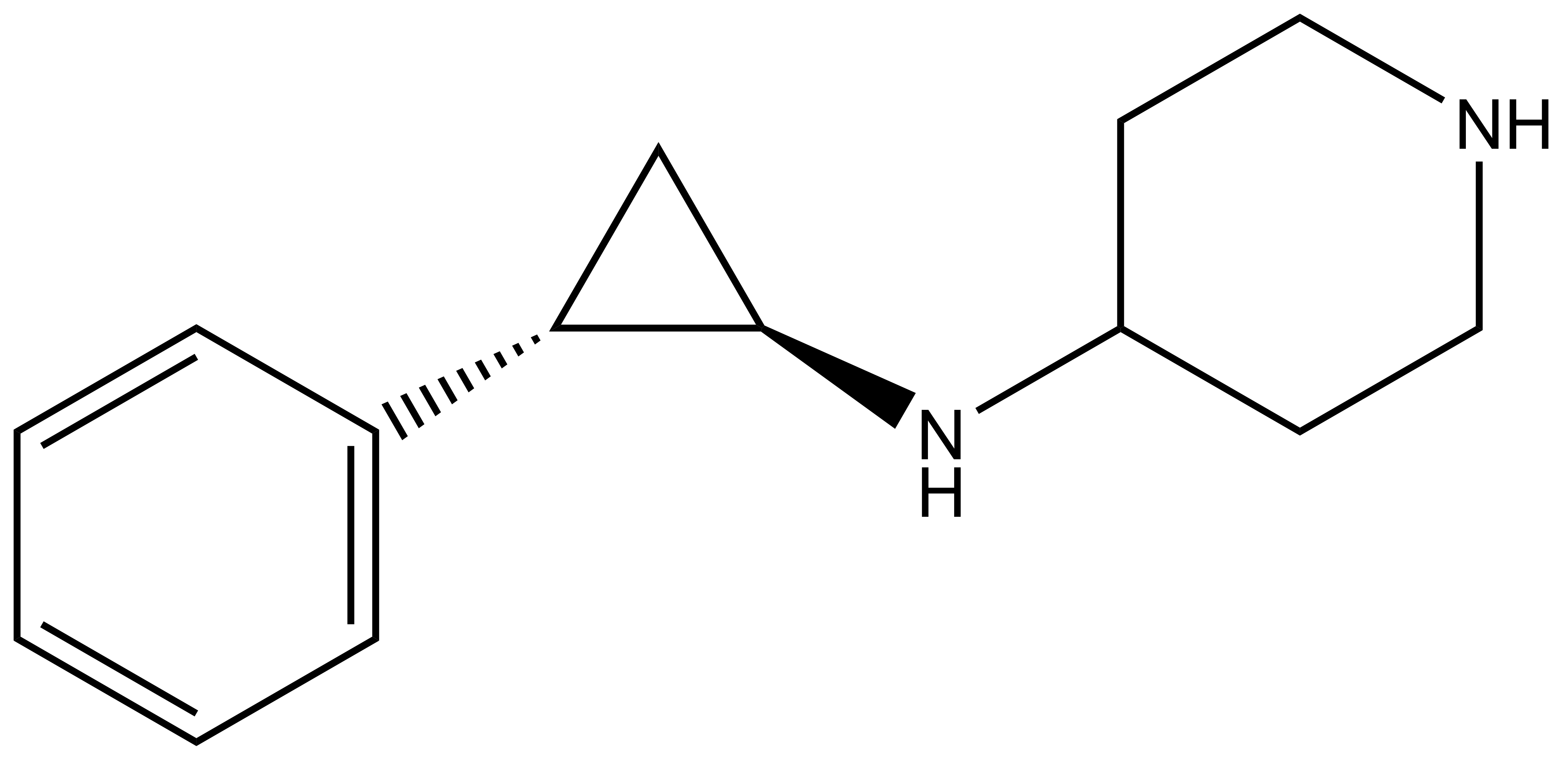
GSK-LSD1 A chemical probe for LSD1Click Cayman, Sigma or Tocris to obtain this probe group newOverview GSK-LSD1 (trans-racemic)MW 216.3FW 289.2 (di-HCl) Lysine specific demethylase 1 (LSD1) is a histone demethylase found in various transcriptional co-repressor complexes. LSD1 is involved in ES cell differentiation, hematopoiesis, and has been described as having a role in Acute Myeloid Leukemia (AML). GlaxoSmithKline has developed an irreversible, mechanism based inhibitor of LSD1, GSK-LSD1, and has made this available as a chemical probe as part of the SGC epigenetics initiative. GSK-LSD1 inhibits LSD1 with an IC50 of 16 nM and is > 1000 fold selective over other closely related FAD utilizing enzymes (i.e. LSD2, MAO-A, MAO-B). GSK-LSD1 induces gene expression changes in cancer cell lines (average EC50 < 5 nM) and inhibits cancer cell line growth (average EC50 < 5 nM). LSD-1 at 10 µM showed no activity against 55 human recombinant receptors in the CEREP ExpresSProfile selectivity/specificity profile (GPCR, transporters, ion channels), except 5-HT1A (49% inhibition) 5-HT transporter (74% inhibition) and dopamine transporter (39 % inhibition).