




Epigenetic Chemical Probes

Group Site: 
Group Leader: 

Peter J. Brown

Group Info

Research Areas

The goal of the Epigenetic Chemical Probes group is to identify small molecules which interact with epigenetic targets with the folowing properties:-

  • IC50 (inhibitors) or Kd (antagonists) < 100nM.
  • >30-fold selectivity over targets in different branches of the phylogenetic tree, and other target families.
  • significant activity in cells < 1 mM.
  • the co-crystal structure of the ligand and protein is solved to better than 2.8A resolution.
  • the chemical probe is widely available to the scientific community without restrictions on use.


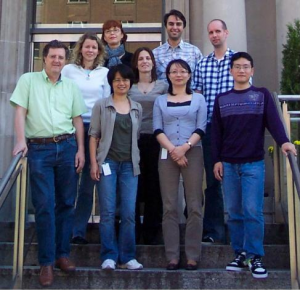
Group Members
Peter J. Brown

Peter received his Ph.D. from the University of Sheffield and performed postdoctoral research at Indiana University with Philip Magnus culminating in the total synthesis of (-)-Pleiomutine, a bis-indole alkaloid.  Prior to joining the SGC in 2009, Peter spent nineteen years at GlaxoSmithKline in various roles, most recently Section Head, Medicinal Chemistry, and was focused on the early Hit-ID phase of Drug Discovery and finding tool compounds for the Nuclear Receptor family of proteins.  Peter’s research interests include using HTS, target-specific arrays, and fragment-based methods to discover probes for epigenetic targets.

David Smil

David received his Ph.D. from the University of Toronto in 2001 under the guidance of Dr. Robert Batey, working to develop new organoboron methodology. During his subsequent postdoctoral fellowship at the University of Ottawa in the laboratories of Dr. Alex Fallis, he successfully completed the multi-step synthesis of complex Taxol® derivatives before moving to MethylGene Inc. (Montreal) in 2003.

There, during a six year tenure as Senior Research Chemist, he was primarily focused on the development of HDAC inhibitors for the treatment of CNS disorders and applications in oncology. In 2009, he joined the SGC as the epigenetic probe program’s first chemist working in the Toronto laboratories, where he continues to explore his interest in early-stage discovery chemistry.

Dalia Barsyte

Dalia Barsyte received her PhD in molecular cell biology and toxicology from the University of Manchester (UK). In her postdoctoral training at the University of Manchester and Ontario Cancer Institute, she investigated mechanisms of MAPK signaling in stress response and c-Myc oncogene driven transcriptional programs associated with cellular stress and epigenetics.  Working for Protagenic Therapeutics Canada Inc, Dalia Barsyte specialized in neuropeptide cellular signaling mechanisms in CNS diseases. She is an author of over 40 scientific publications and her interests include transcriptional and epigenetic programs that influence cell homeostasis, differentiation and carcinogenesis.

Hong Wu

Hong received her Ph.D. in biochemistry from DalhousieUniversity and had her postdoctoral training at University of Toronto with Dr. Lori Frappier.  Hong then joined a Toronto-based biotech company as a scientist in the department of protein/antibody engineering, focused on generating recombinant antibodies for various biomarkers.    In 2004, Hong joined the SGC.  As the team-leader, Hong and her team have focused on solving crystal structures of human histone modification enzymes. Hong’s research interests include using structural and biochemical methods to study the molecular mechanism of epigenetic regulation of gene expression.
Mila Dombrowski

Ludmila received her MSc in Biochemistry from the State University of Tashkent (former USSR) in 1988 and since then she has been working for various biotech companies and research institutions.

Ludmila joined SGC at the very first days of the company’s foundation (2003). Her excellent technical knowledge of various techniques and solid experience on the bench along with extensive research experience has been highly valuable and useful for the department’s publications and overall success in achieving our organization’s targets.

Hong Zeng

Hong Zeng received her Master’s degree from York University and has worked in various academic as well as industrial laboratories.  Her work experience ranges from molecular biology to cell biology, immunology and protein biochemistry.  She joined the SGC in 2004.

Wenyu Yu
Wenyu received his Ph.D from Peking Univervisity in 2009 and then joined SGC epigenetic group as a postdoc. His main interest now is to develop different assays to find inhibitors against SETD8 and DOT1L with STD-NMR, DSF, enzymatic assay, ITC, etc.
Yuri Bolshan

Yuri received his undergraduate degree from the University of Waterloo. In 2003, he began his doctoral studies under the supervision of Professor Robert Batey at the University of Toronto, focusing on rhodium- and copper-catalyzed reactions of organoboron compounds. From 2008-2010, he was a JSPS postdoctoral fellow in the laboratory of Professor Tohru Fukuyama at the University of Tokyo, where he worked on the total synthesis of oxycodone. Currently, Yuri is developing chemical probes for Polycomb-group proteins.

Maria Mangos

Maria received her PhD in bio-organic chemistry from McGill University and soon after worked at a Montreal-based biotech startup company where she coordinated the set-up of a chemistry facility and developed compounds for the company's respiratory diseases therapeutic platforms.  She later joined the National Research Council of Canada to conduct postdoctoral work on epigenetic mechanisms and signaling pathways in the opportunistic pathogen, C. albicans.  In late 2008, Maria joined the SGC as a PDF and works on high throughput screening of histone acetyltransferases for drug discovery.  She has also worked with peptide arrays to identify recognition motifs for protein acetyl binding domains (bromodomains) in collaboration with SGC (Oxford) site partners. 

Publications

Feng Liu, Dalia Barsyte-Lovejoy, Abdellah Allali-Hassani, Yunlong He, J. Martin Herold, Xin Chen, Christopher M. Yates, Stephen V. Frye, Peter J. Brown, Jing Huang, Masoud Vedadi, Cheryl H. Arrowsmith, and Jian Jin.  Optimization of Cellular Activity of G9a Inhibitors 7-Aminoalkoxy-quinazolines.  J. Med. Chem., 2011, 54 (17), pp 6139–6150.


Masoud Vedadi, Dalia Barsyte-Lovejoy, Feng Liu, Sylvie Rival-Gervier, Abdellah Allali-Hassani, Viviane Labrie, Tim J. Wigle, Peter A. DiMaggio, Gregory A. Wasney, Alena Siarheyeva, Aiping Dong, Wolfram Tempel1, Sun-Chong Wang, Xin Chen, Irene Chau, Thomas J. Mangano, Xi-ping Huang, Catherine D. Simpson, Samantha G. Pattenden, Jacqueline L. Norris, Dmitri B. Kireev, Ashutosh Tripathy, Aled Edwards, Bryan L. Roth, William P. Janzen, Benjamin A. Garcia, Arturas Petronis, James Ellis, Peter J. Brown, Stephen V. Frye, Cheryl H. Arrowsmith and Jian Jin.  A chemical probe selectively inhibits G9a and GLP methyltransferase activity in cells.  Nature Chemical Biology 2011 (7) p566-574.


J. Martin Herold, Tim J. Wigle, Jacqueline L. Norris, Robert Lam, Victoria K. Korboukh, Cen Gao, Lindsey A. Ingerman, Dmitri B. Kireev, Guillermo Senisterra, Masoud Vedadi, Ashutosh Tripathy, Peter J. Brown, Cheryl H. Arrowsmith, Jian Jin, William P. Janzen, and Stephen V. Frye.  Small-Molecule Ligands of Methyl-Lysine Binding Proteins  J. Med. Chem. 2011 54 (7) 2504-11.


Tim J. Wigle, Laurel M. Provencher, Jacqueline L. Norris, Jian Jin, Peter J. Brown, Stephen V. Frye, and William P. Janzen Accessing Protein Methyltransferase and Demethylase Enzymology Using Microfluidic Capillary Electrophoresis  .  Chemistry & Biology 17(7) 695-704 (2010).


Liu, F.; Chen, X.; Allali-Hassani, A.; Quinn, A. M.; Wigle, T. J.; Wasney, G. A.; Dong, A.; Senisterra, G.; Chau, I.; Siarheyeva, A.; Norris, J. L.; Kireev, D. B.; Jadhav, A.; Herold, J. M.; Janzen, W. P.; Arrowsmith, C. H.; Frye, S. V.;  Brown, P. J.; Simeonov, A.; Vedadi, M.; Jin, J.  Protein Lysine Methyltransferase G9a Inhibitors: Design, Synthesis, and Structure Activity Relationships of 2,4-Diamino-7-aminoalkoxy-quinazolines.  J. Med. Chem. 2010, 53, 5844-5857.


Feng Liu, Xin Chen, Abdellah Allali-Hassani, Amy M. Quinn, Gregory A. Wasney, Aiping Dong, Dalia Barsyte, Ivona Kozieradzki, Guillermo Senisterra, Irene Chau, Alena Siarheyeva, Dmitri B. Kireev, Ajit Jadhav, J. Martin Herold, Stephen V. Frye, Cheryl H. Arrowsmith, Peter J. Brown, Anton Simeonov, Masoud Vedadi and Jian Jin.  Discovery of a 2,4-Diamino-7-aminoalkoxyquinazoline as a Potent and Selective Inhibitor of Histone Lysine Methyltransferase G9a  J. Med. Chem., 2009, 52 (24), 7950–7953.

Contact

peterj [dot] brown[at]utoronto [dot] ca  (416) 978-7408