Insights and Lessons Learned: Highlights from the MAINFRAME 2026 Symposium
A Community Taking Shape in AI-Driven Drug Discovery
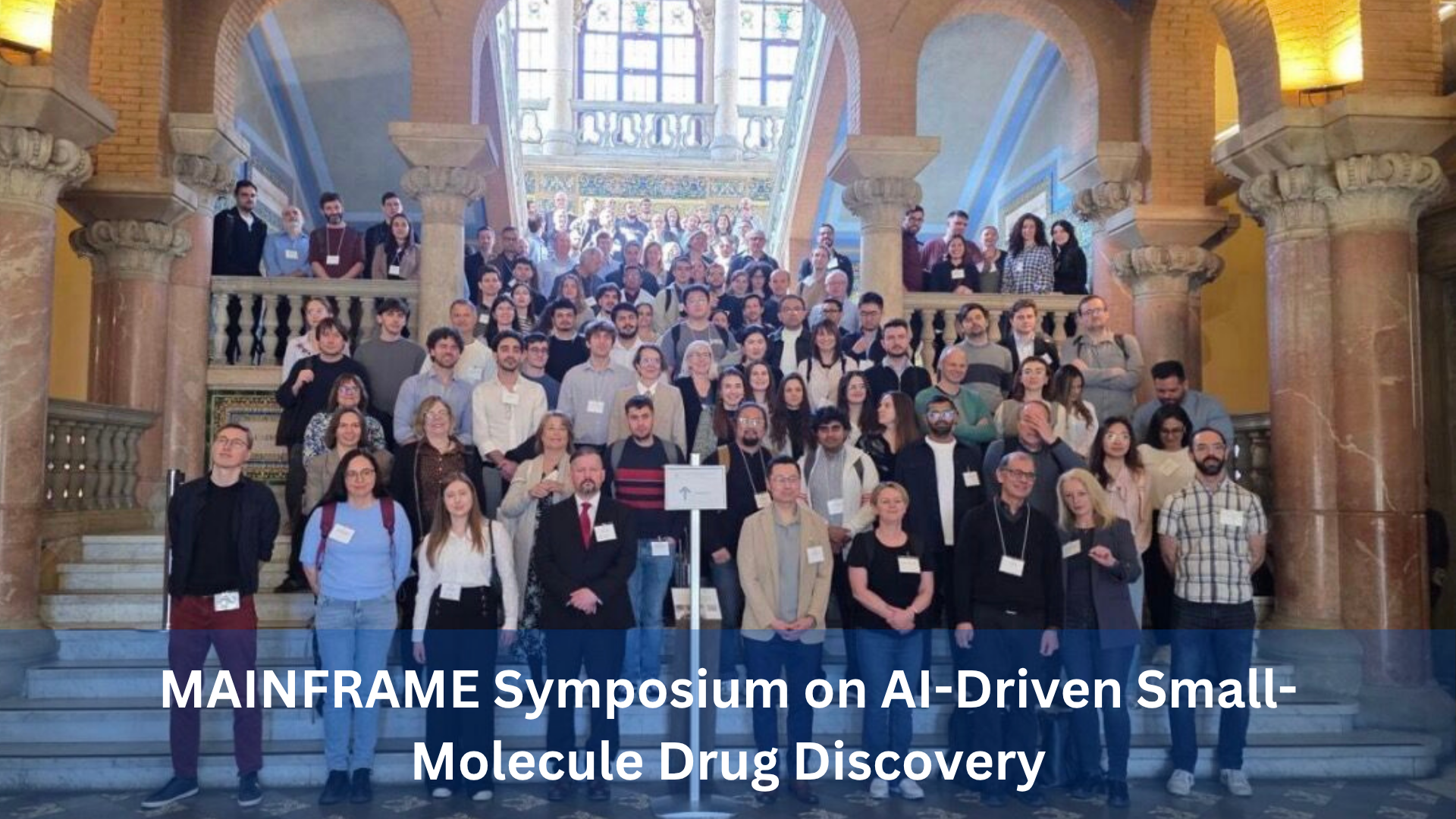
In March 2026, the first MAINFRAME Symposium brought together more than 180 researchers from academia and industry in Barcelona, marking a defining moment for a rapidly emerging field. What began just over a year ago as an idea to create an open, global community focused on machine learning for drug discovery has quickly evolved into a growing international network now spanning more than 250 members across 45+ countries.
This inaugural meeting highlighted a community starting to unite around shared challenges, shared data, and a collective ambition to transform early-stage drug discovery.
From Momentum to Method: Where Science Stands
Across keynotes, talks, and discussions, a consistent message emerged: AI is no longer a future promise in drug discovery. It is already making significant contributions to real workflows. Presentations showcased how machine learning, physics-based modeling, and generative AI are being integrated to design compounds, prioritize hits, and accelerate virtual screening. Foundation models trained on large, multimodal datasets are beginning to show utility across applications ranging from retrosynthesis to molecular property prediction.
At the same time, benchmarking efforts such as CACHE and the Target 2035 DREAM challenges reinforced an important reality: performance remains highly context-dependent, particularly for difficult or understudied targets. Classical approaches continue to hold their ground, especially when combined with active learning strategies.
The takeaway was not competition between methods, but rather a convergence toward hybrid, data-informed approaches that can be rigorously tested and compared.
The Data Problem Remains Central
Despite advances in modeling, one bottleneck remains clear: data.
Discussions around ADMET prediction and hit discovery highlighted the continued need for high-quality, well-annotated datasets and robust benchmarking frameworks. Community-driven initiatives and blind challenges are increasingly seen as essential infrastructure to evaluate progress and avoid overfitting to narrow benchmarks. This is precisely where initiatives like Target 2035, and by extension MAINFRAME, play a critical role. By generating large-scale, open protein–ligand datasets and enabling systematic benchmarking, they aim to shift the field toward reproducibility, comparability, and ultimately, predictive performance at scale.
Building the Right Ecosystem
Beyond science, the symposium faced a deeper question: how should this field organize itself?
There was strong alignment around the need to coordinate efforts, avoid fragmentation, and ensure that benchmarking remains both meaningful and community-driven. As participation expands, the design of challenges, datasets, and evaluation frameworks becomes increasingly important. The goal is not simply to generate more activity, but to create a coherent system where results can be compared, reproduced, and built upon.
Industry engagement is also evolving within this context. While caution remains, there is increasing recognition that participating in open science initiatives delivers tangible value.
The Infrastructure Behind Progress
These discussions point to a broader shift: benchmarking and data-sharing are becoming core infrastructure for the field.
Rather than operating as isolated efforts, there is a growing move toward coordination and standardization. The launch of BEACON (the Benchmarking, Evaluation, and Assessment Consortium for science) during the symposium reflects this transition. By bringing together leading benchmarking initiatives under a single, open framework, BEACON aims to provide a more structured and aligned environment for evaluating predictive performance across drug discovery tasks. In a field defined by rapid methodological innovation, this type of infrastructure is critical, not only to measure progress but to guide it.
Listening to the Community: Roundtables as a Core Feature
Beyond the scientific presentations, the symposium was intentionally designed to create space for dialogue.
Two dedicated roundtables focused on AI benchmarking and community engagement brought forward perspectives that are often underrepresented in formal presentations. Participants openly discussed both the opportunities and the limitations of current approaches, raising concerns around validation, dataset quality, and the proliferation of benchmarking challenges, while also sharing concrete examples of progress and success. These discussions reinforced a key principle behind MAINFRAME: progress in this space will not come from isolated efforts, but from continuous, transparent exchange across the community.
SGC and the Role of Open Science
As a founding driver of Target 2035 and architect of MAINFRAME, the Structural Genomics Consortium (SGC) has played a central role in shaping this ecosystem. The goal is to enable a significant advancement in early drug discovery by generating high-quality, openly accessible protein–ligand datasets and supporting the development of predictive models that can operate across the entire proteome at scale.
MAINFRAME is a critical component of this effort, bringing together computational scientists, chemists, and experimentalists to collaborate in an open environment, test emerging methods, and establish shared benchmarks.
What was evident in Barcelona is that this approach is gaining momentum. There is an increasing willingness across sectors to participate in open, collaborative frameworks that emphasize collective progress over individual gains.
What Comes Next
The MAINFRAME Symposium points to a field that is not only accelerating but maturing. This is only the first of many gatherings under the MAINFRAME and Target 2035 umbrella. As new datasets are generated, new benchmarks established, and new models developed, the role of the community will only become more central. Building on this momentum, a new DEL-ML benchmarking challenge using SMILES-based representations will be launched soon, focused on advancing model training and evaluation across shared datasets.
For those working at the intersection of AI and drug discovery, MAINFRAME remains open to new members.
Join MAINFRAME here: https://aircheck.ai/mainframe