
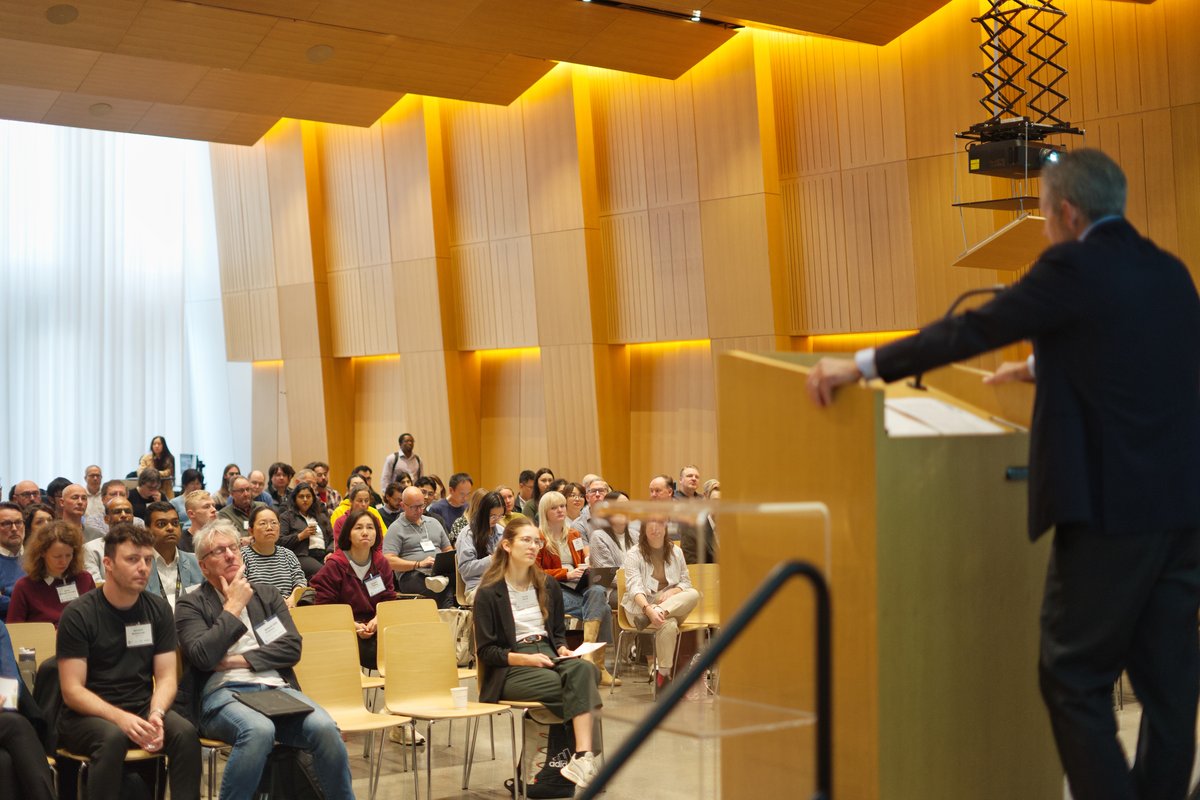
Every protein, together: Highlights from the first Target 2035 Symposium in Toronto
What would it take to develop a pharmacological tool for every human protein?
On September 23, more than 170 participants from academia, industry and the non-profit sector gathered in Toronto for the first Target 2035 Symposium: Advancing Data-Driven Drug Discovery (check the photos). The event reached capacity well ahead of time, reflecting growing international interest in this ambitious mission. Together with the workshops the day before, more than 200 people took part. Hosted by the Structural Genomics Consortium (SGC) and UHN’s Collaborative Centre for Drug Discovery (C2D2), the symposium brought together representatives from all eight SGC sites, alongside industry members, technology partners and collaborators from around the world.
"The scientific challenge is significant, but so is the opportunity," Brad Wouters, Executive Vice President of Science and Research at UHN, told the room in his opening remarks. Over the day, four ideas kept coming back.
One community, one goal
Target 2035 starts from an uncomfortable fact: thousands of human genes remain barely studied, because scientists have no tools to ask what they do. "In our own little universes, we study proteins that we know," said the SGC CEO, Aled Edwards. "But the vastness of what we don't know is underappreciated, and almost ignored."
No single lab can close that gap. As Brad Wouters put it, "the biggest challenges in biomedical research cannot be solved by any one organization alone." The room reflected that. Scientists from Pfizer, Amgen, the Acceleration Consortium and the University of Melbourne chaired sessions, and speakers came from SGC sites, hospitals, universities and companies.
After a welcome from Cheryl Arrowsmith, Chief Scientific Officer of SGC Toronto and co-Director of C2D2, the Symposium marked a milestone for the SGC network: the launch of SGC Melbourne, our first site in Australasia. Led by Professor Megan Maher, who also chaired the Symposium’s opening session, SGC Melbourne brings together the University of Melbourne, WEHI, Peter MacCallum Cancer Centre and Murdoch Children’s Research Institute to generate open data for Target 2035.
“Target 2035 is a global mission, and achieving it requires a distributed international network of laboratories with complementary scientific strengths,” said SGC CEO Aled Edwards."Target 2035 is a global mission, and achieving it requires a distributed international network of laboratories with complementary scientific strengths," said Edwards.
Read the announcement on our website, and the University of Melbourne's story and video.
Open by default
For more than two decades, the SGC has pioneered a model of pre-competitive collaboration in which academic researchers, industry partners and funders work together to develop and openly share scientific tools and knowledge. Target 2035 builds on that foundation, bringing together a growing international network to generate the experimental data, technologies and computational tools needed to accelerate drug discovery. At the Symposium, that principle ran through almost every talk, from open screening platforms to open infrastructure for machine learning, presented by Shaghayegh Reza (SGC Toronto).
Openness also means sharing what doesn't work. "Even if our project fails, which is just part of life as a scientist, the record still exists," said Rachel Harding of SGC Toronto. "It's still out there, and we're still moving forward." Claudia Tredup (SGC Frankfurt), who spoke on chemical tools for non-hormonal contraception, knows this well: her team recently ruled out ABHD2 as a contraceptive target, narrowing the search for everyone working in the field.
Bringing these experimental datasets together, including both positive and negative results, is central to AIRCHECK, the open data infrastructure supporting Target 2035. By making diverse protein–ligand interaction data accessible and AI-ready, AIRCHECK helps connect experimental data generation with machine learning and computational discovery. "We have a lot of different labs doing experiments and generating different assays," said Kiana Jenabidehkordi, AIRCHECK Project Manager at UHN. "At the end of the day, we need a place where this data becomes available to the public, and that place is AIRCHECK."
From the bench to the model, and back
Why is Target 2035 possible now? Edwards points to structural biology. For 30 years it worked one protein at a time, until AlphaFold2 learned from the accumulated data to predict new structures. "If we collect common data and make the data available to everybody, we'll be able to do computationally what we can't do experimentally."
The program traced how that data is generated, step by step.
Protein. Kristof Bozovicar described SGC's "human proteome assembly line" for high-throughput protein production. A new community guide led by Nicola Burgess-Brown (SGC UCL), EXPERT, now sets out how to record that work so machine learning can learn from it.
Ligands at scale. Leanne Wybenga-Groot, who leads SGC's open DNA-encoded library (DEL) platform, and Søren Jensby Nielsen (Amgen) showed how DEL screening generates hits and data, at scale. Jianxian Sun (SGC Toronto) presented automated E-ASMS. The 2nd Annual E-ASMS Meeting, sponsored by Thermo Fisher Scientific, ran alongside the Symposium from September 21 to 25.
Probes. In a session chaired by Santha Santhakumar (Acceleration Consortium), speakers showed how medicinal chemistry expands hits into probes, helped by new tools: Promega's BRETSA™ for live-cell target engagement, self-driving labs and direct-to-biology chemistry.
Models. Finally, the data trains models, from deep learning for structure-based design (David Koes, University of Pittsburgh) to the generative approaches in the keynote by Pfizer's Djork-Arné Clevert, "Feeding the Beast."
The loop will run both ways. "Those predictions still need wet-lab validation," said Rocher Leung, a PhD student at SGC Toronto. Models point to the next experiment, and every experiment makes the next model better.
Beyond the symposium: A week of science and collaboration
The symposium was the centrepiece of a broader SGC Science Week, which included four complementary activities: the annual E-ASMS Meeting, advancing experimental screening technologies; an AIRCHECK workshop hosted at Microsoft, focused on open data infrastructure and AI-ready datasets; a BRETSA workshop with Promega, exploring live-cell target engagement; and a career panel organized with UHN, connecting trainees with scientists and industry professionals. Together, these activities provided opportunities for hands-on learning, scientific exchange and networking beyond the symposium itself.
Thank you, and what's next
As Brad Wouters put it, "the strength of Target 2035 lies in its community." Thank you to every speaker, chair, and attendee who travelled to Toronto; to the SGC's academic, industry, and funding partners; and to Cheryl Arrowsmith, the organizing committee, and our SGC Toronto team for making the week possible.
The next Target 2035 Symposium will take place in Frankfurt on March 1–3, 2027, followed by our symposium in Toronto on September 20–22, 2027. We hope to see you there.
The Target 2035 Symposium is supported by the Innovative Health Initiative Joint Undertaking (IHI JU) under grant agreement No 101252959. The JU receives support from the European Union's Horizon Europe research and innovation programme, COCIR, EFPIA, EuropaBio, MedTech Europe, Vaccines Europe, Enamine, and The Hospital for Sick Children.
Photos: Tianyi Zhang