
Compound and inactive control can be requested here.
NR4A receptors (NR4A1–3) are orphan nuclear receptors sharing ~66–69% sequence identity and functioning as transcription factors through monomeric, homodimeric, or RXR-heterodimeric forms. They regulate gene expression via response elements such as NBRE, NurRE, and DR5. Among them, NR4A2 (Nurr1) is highly expressed in the central nervous system and is associated with neuroprotective and anti-neuroinflammatory effects, with relevance to neurodegenerative diseases including Parkinson’s, Alzheimer’s, and multiple sclerosis.
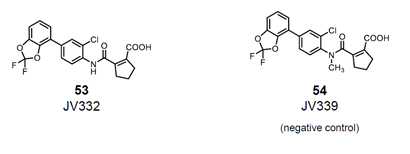
Chemical structures of JV332 and the negative control JV339.
JV332 (compound 53) is a potent NR4A agonist derived from optimization of vidofludimus-based scaffolds. It demonstrates strong agonistic activity across NR4A receptors and promotes neuroprotective gene expression. A structurally related inactive compound (JV339, compound 54) serves as a negative control.
Biological activity summary:
Physical and chemical properties for JV332 | |
Molecular weight | 421,78 |
Molecular formula | C20H14ClF2NO5 |
IUPAC name | 2-((2-chloro-4-(2,2-difluoro-1,3-benzodioxol-4-yl)phenyl)carbamoyl)cyclopent-1-ene-1-carboxylic acid |
AlogP | 5.71 |
TPSA | 84.86 |
No. of chiral centers | 0 |
No. of rotatable bonds | 4 |
No. of hydrogen bond acceptors | 4 |
No. of hydrogen bond donors | 2 |
Storage | Stable as a solid at room temperature. Store DMSO stock solutions (10 mM) at -20 °C. Use only 1 freeze/thaw cycle per aliquot. DMSO stocks beyond 3-6 months or 2 freeze/thaw cycles should be tested for activity before use |
Dissolution | Soluble in DMSO up to 10 mM |
Physical and chemical properties for JV339 | |
Molecular weight | 435,81 |
Molecular formula | C21H16ClF2NO5 |
IUPAC name | 2-((2-chloro-4-(2,2-difluoro-1,3-benzodioxol-4-yl)phenyl)(methyl)carbamoyl)cyclopent-1-ene-1-carboxylic acid |
AlogP | 5.27 |
TPSA | 76.07 |
No. of chiral centers | 0 |
No. of rotatable bonds | 4 |
No. of hydrogen bond acceptors | 4 |
No. of hydrogen bond donors | 1 |
Storage | Stable as a solid at room temperature. Store DMSO stock solutions (10 mM) at -20 °C. Use only 1 freeze/thaw cycle per aliquot. DMSO stocks beyond 3-6 months or 2 freeze/thaw cycles should be tested for activity before use |
Dissolution | Soluble in DMSO up to 10 mM |
References:
Sai M, Vietor J, Kornmayer M, et al. Structure-Guided Design of Nurr1 Agonists Derived from the Natural Ligand Dihydroxyindole. J Med Chem. 2023;66(19):13556-13567. doi:10.1021/acs.jmedchem.3c00852
Stiller T, Gege C, Saeb W, et al. Carboxylic Acid Bioisosteres Boost Nurr1 Agonist Selectivity. J Med Chem. 2025;68(15):16212-16226. doi:10.1021/acs.jmedchem.5c01140
Vietor J, Busch R, López-García Ú, et al. Structural Tuning of Vidofludimus for High-Efficacy NR4A Agonism. J Med Chem. 2026;69(3):3343-3361. doi:10.1021/acs.jmedchem.5c03217