
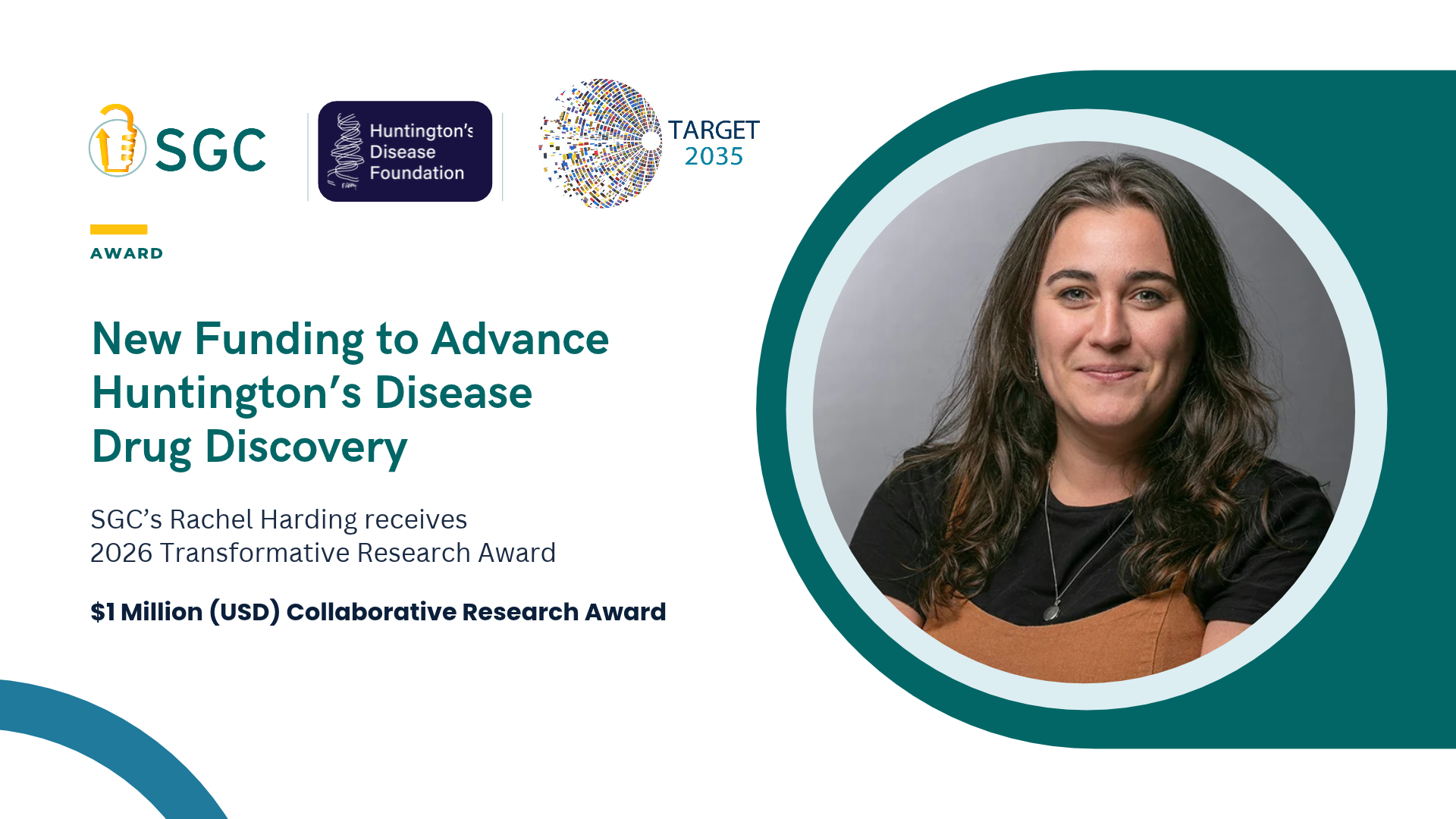
SGC's Rachel Harding Secures Huntington's Disease Foundation Funding to Advance Drug Discovery
The Structural Genomics Consortium (SGC) is pleased to announce that Dr. Rachel Harding, Principal Investigator at SGC-Toronto and Assistant Professor at the University of Toronto's Leslie Dan Faculty of Pharmacy, is leading one of two research teams selected for the Huntington's Disease Foundation's (HDF) 2026 Transformative Research Awards.
The $1 million (USD) collaborative award, with nearly half of the funding allocated to SGC, will support the project “Structure-Guided Development of Small Molecule Therapeutics Targeting the Huntingtin Protein,” aimed at advancing new therapeutic approaches for Huntington's disease.
Huntington's disease is an inherited neurodegenerative disorder that progressively affects movement, cognition, and behaviour. The disease is caused by a mutation in the gene encoding huntingtin, a protein that has proven challenging to target with conventional drug discovery approaches.
Building on the team's discovery of a small molecule that binds directly and selectively to huntingtin, the project aims to develop compounds that recruit the cell's natural protein-disposal machinery to remove harmful huntingtin. This approach could open a path toward future treatments that may be administered orally.
The project brings together researchers from SGC Toronto, SGC Frankfurt, and collaborating organizations, including Matthieu Schapira (SGC Toronro) and Santha Santhakumar (Acceleration Consortium), Stefan Knapp (SGC Frankfurt), Agustina Rodriguez-Granillo (Schrödinger), Jeffery Carroll (Allen Institute), and Peter B. Sampson (Agora Open Science Trust).
HDF's Transformative Research Awards are the foundation's largest research grants, supporting innovative research with the potential to advance treatments for Huntington's disease. In 2026, HDF selected two collaborative research teams, each receiving $1 million in funding.
The award supports SGC's efforts to advance early-stage drug discovery through collaborative research and the development of new approaches to challenging therapeutic targets.