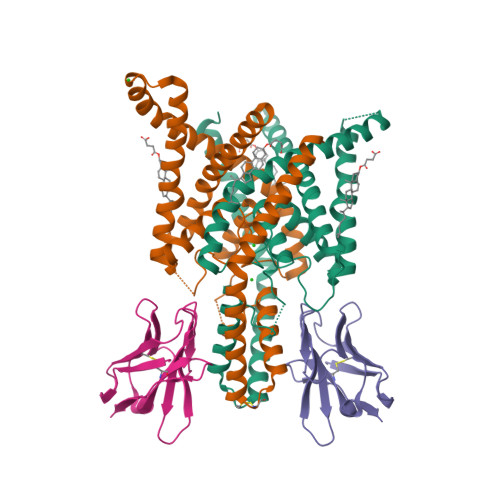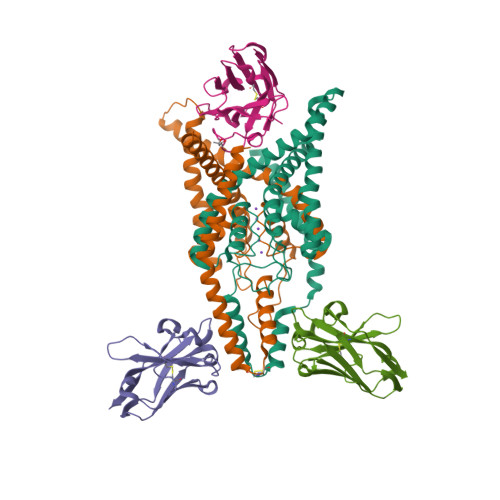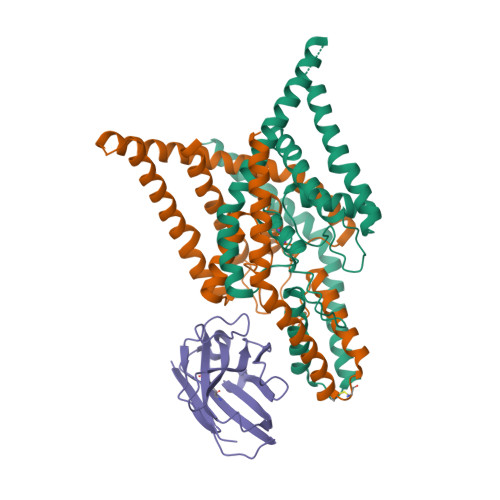
The probe and control may be requested here.
| Probe | Negative control | |
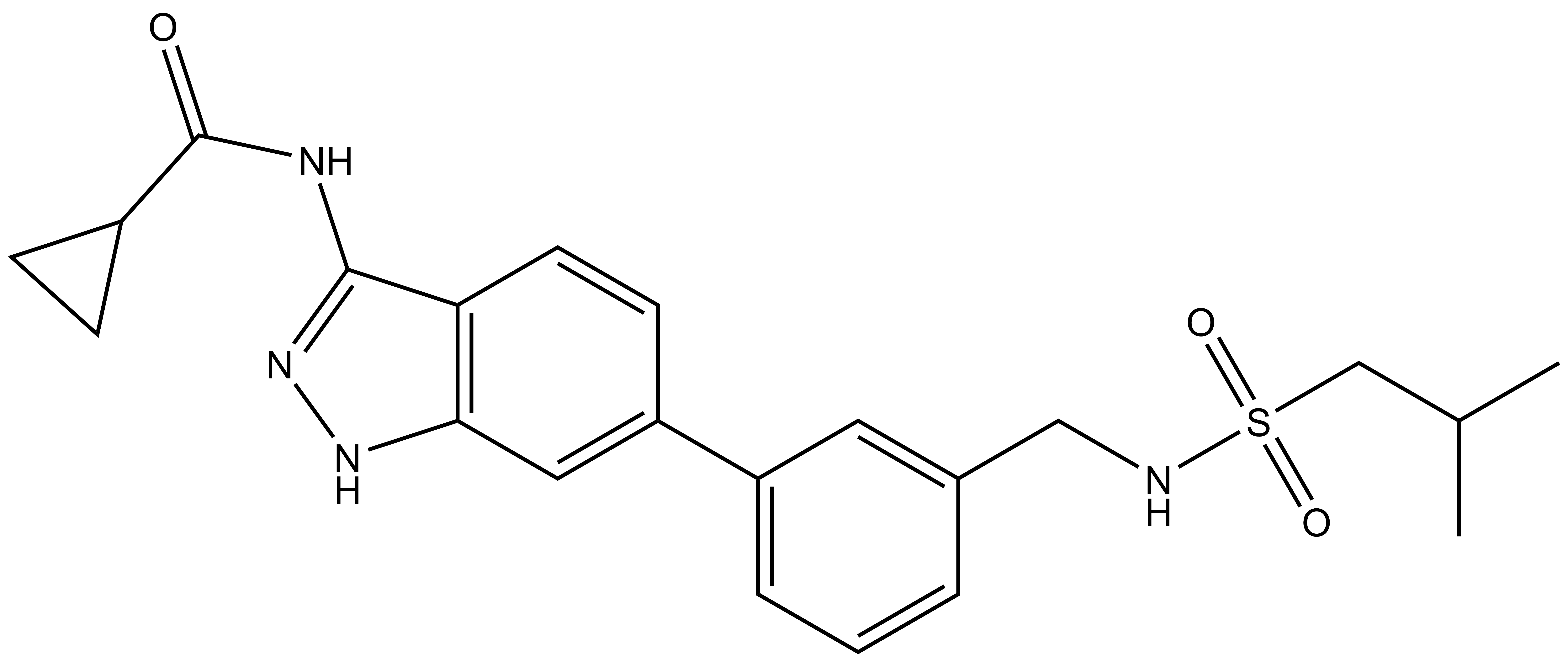 | 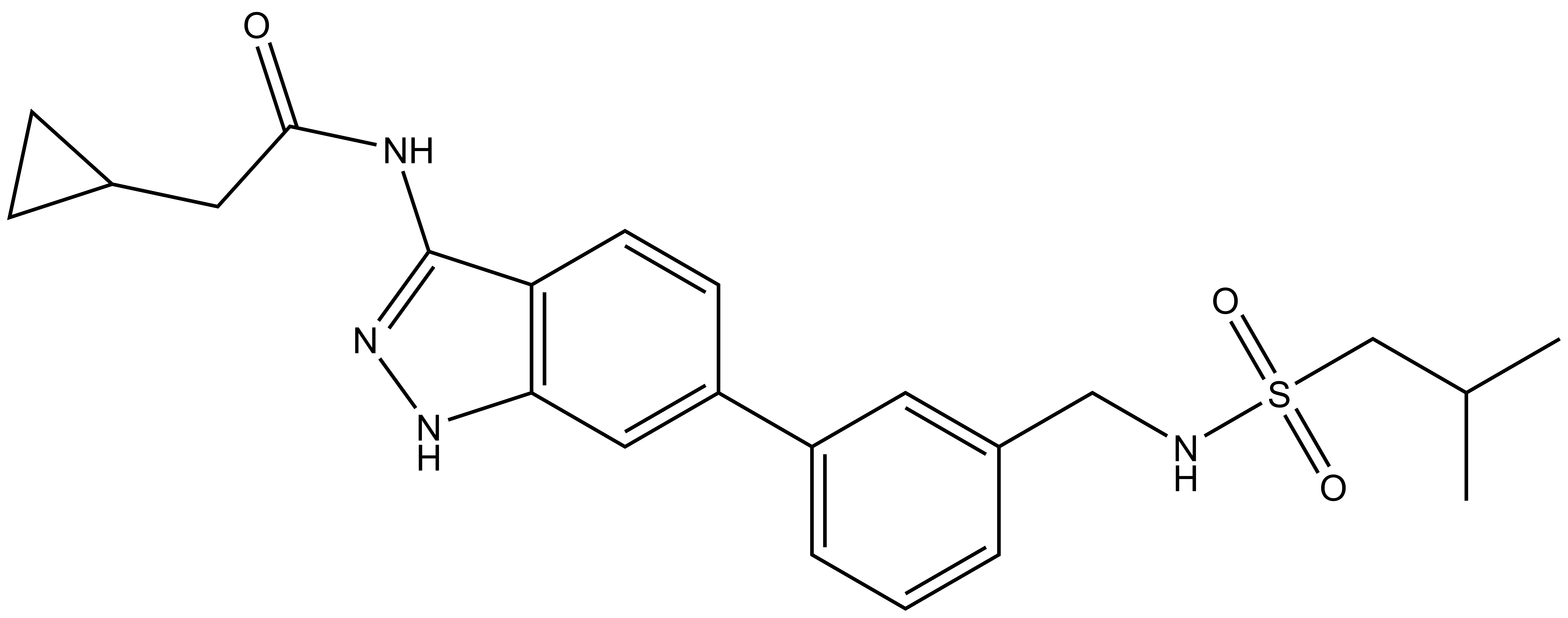 | |
SGC-CDKL2/AAK1/BMP2K-1 | CDKL2/AAK1/BMP2K -1N |
From a library of acylaminoindazoles, we identified a potent and cell-active chemical probe (SGC-CDKL2/AAK1/BMP2K-1) that inhibits cyclin-dependent kinase-like 2 (CDKL2). Comprehensive evaluation of kinome-wide selectivity confirmed that this chemical probe demonstrates good selectivity. A structurally similar analog(SGC-CDKL2/AAK1/BMP2K-1N) was characterized as a negative control that does not bind to CDKL2, AAK1, or BMP2K in corresponding cellular target engagement assays. SGC-CDKL2/AAK1/BMP2K-1 is devoid of AAK1 and BMP2K inhibition when used at an appropriate concentration (≤1 µM in cells). At biologically relevant concentrations (≤1 µM), our chemical probe inhibited EB2 phosphorylation in rat primary neurons. A chemical probe that inhibits AAK1 and BMP2K, SGC-AAK1-1, represents a compound that can be profiled in parallel to discern whether an observed phenotype is driven by CDKL2 inhibition. When used at ≤1 µM in cell-based assays, our chemical probe set can help the community further characterize the underexplored roles of CDKL2.
Biological activity summary:
| Physical and chemical properties for SGC-CDKL2/AAK1/BMP2K-1 | |
| Molecular weight | 426.54 |
| Molecular formula | C22H26N4O3S |
| IUPAC name | N-(6-(3-(((2-methylpropyl)sulfonamido)methyl)phenyl)-1H-indazol-3-yl)cyclopropanecarboxamide |
| ClogP | 3.24 |
| PSA | 112.33 |
| No. of chiral centers | 0 |
| No. of rotatable bonds | 9 |
| No. of hydrogen bond acceptors | 5 |
| No. of hydrogen bond donors | 3 |
| Storage | Stable as a solid at room temperature. DMSO stock solutions (up to 10 mM) are stable at -20oC |
| Dissolution | Soluble in DMSO up to 10 mM |
| Physical and chemical properties for SGC-CDKL2/AAK1/BMP2K-1N | |
| Molecular weight | 440.56 |
| Molecular formula | C23H28N4O3S |
| IUPAC name | 2-cyclopropyl-N-(6-(3-(((2-methylpropyl)sulfonamido)methyl)phenyl)-1H-indazol-3-yl)acetamide |
| ClogP | 3.63 |
| PSA | 112.33 |
| No. of chiral centers | 0 |
| No. of rotatable bonds | 10 |
| No. of hydrogen bond acceptors | 5 |
| No. of hydrogen bond donors | 3 |
| Storage | Stable as a solid at room temperature. DMSO stock solutions (up to 10 mM) are stable at -20oC |
| Dissolution | Soluble in DMSO up to 10 mM |
SGC-CDKL2/AAK1/BMP2K-1 was profiled in the DiscoverX MAX assay against 403 wild-type kinases at 1 μM. Only 2 kinases showed PoC <10 giving an S10(1 μM) = 0.002. When the PoC <40 fraction was examined, 10 kinases were included (S35(1 μM) = 0.022). Potential off-targets within the S40(1 μM) fraction were tested via biochemical enzymatic and/or NanoBRET target engagement assays. Data corresponding with off-target kinase activity is shown in the table below.
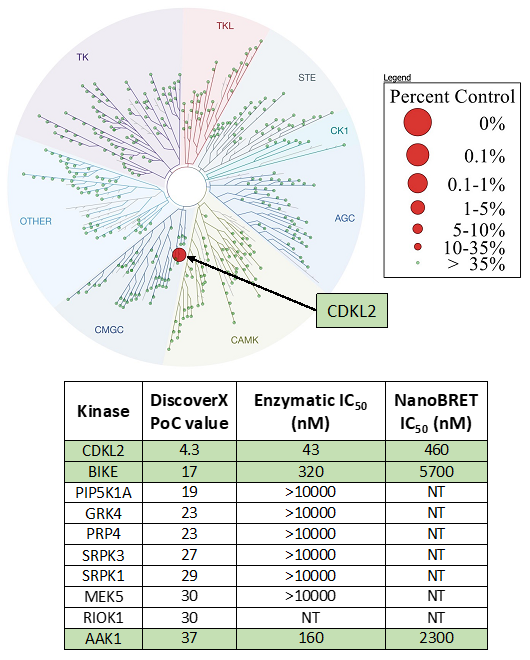
Figure 2: SGC-CDKL2/AAK1/BMP2K-1 was profiled in the DiscoverX MAX assay against 403 wild-type kinases at 1 μM and off-target kinases inhibited PoC <40 were tested in an orthogonal assay. Rows colored green correspond with CDKL2, AAK1, and BMP2K. No other kinases demonstrate enzymatic IC50 values within 30-fold of the CDKL2 enzymatic assay IC50 value.
A NanoBRET assay was utilized to assess the binding affinity of SGC-CDKL2/AAK1/BMP2K-1 to CDKL2, AAK1, and BMP2K. The negative control shows no binding affinity for CDKL2, AAK1, or BMP2K.
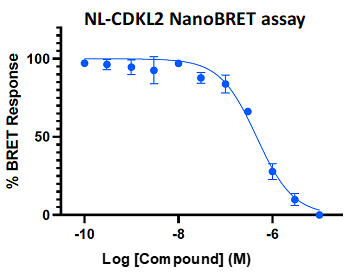


Figure 3: SGC-CDKL2/AAK1/BMP2K-1 was profiled in the CDKL2, AAK1, and BMP2K NanoBRET assays.
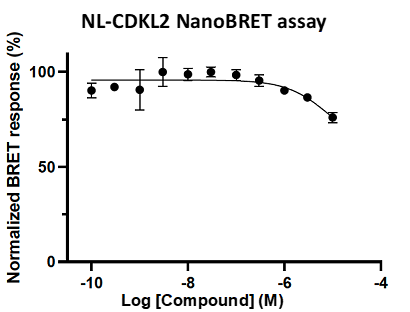
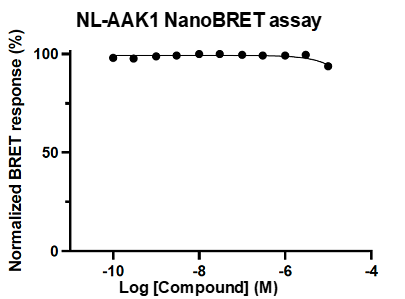
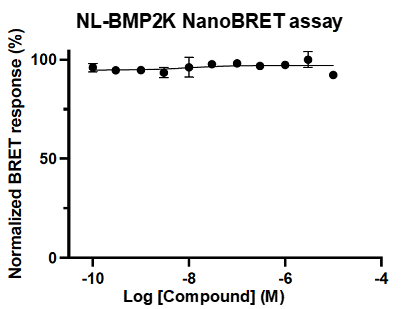
Figure 4: SGC-CDKL2/AAK1/BMP2K-1N was profiled in the CDKL2, AAK1, and BMP2K NanoBRET assays.
Bashore, F. M.; Min, S. M.; Chen, X.; Howell, S.; Rinderle, C. H.; Morel, G.; Silvaroli, J. A.; Wells, C. I.; Bunnell, B. A.; Drewry, D. H.; Pabla, N. S.; Ultanir, S. K.; Bullock, A. N.; Axtman, A D. Discovery and Characterization of a Chemical Probe for Cyclin-Dependent Kinase-Like 2. ACS Med Chem Lett , doi: 10.1021/acsmedchemlett.4c00219.
Bashore, F. M.; Min, S. M.; Chen, X.; Howell, S.; Rinderle, C. H.; Morel, G.; Silvaroli, J. A.; Wells, C. I.; Bunnell, B. A.; Drewry, D. H.; Pabla, N. S.; Ultanir, S. K.; Bullock, A. N.; Axtman, A D. Discovery and Characterization of a Chemical Probe for Cyclin-Dependent Kinase-Like 2. BioRxiv, doi: 10.1101/2024.05.12.593776.
The SGC is a global private public partnership focused on understanding the functions of all human proteins. Over the past two decades, we have determined thousands of protein structures, and developed new chemical probes. We are now scaling up these efforts along with the computational community, using artificial intelligence to transform early drug discovery. Explore our work and see how we are accelerating drug discovery through open-access research.
The Structural Genomics Consortium at the University of Toronto is thrilled to announce that Assistant Professor and Principal Investigator, Dr. Rachel Harding, has been honored with the Hereditary Disease Foundation’s (HDF) 2024 Nancy S. Wexler Young Investigator Prize. This award is given annually to an early-career researcher who demonstrates exceptional quality, innovation, and commitment in the field of hereditary disease research.
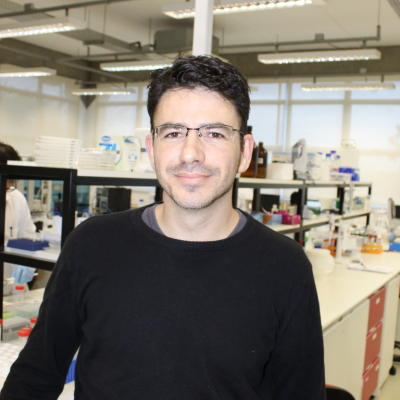
Dr. Bengtson holds a PhD in Biochemistry and Molecular Biology from São Paulo University (USP), awarded in 2002. He completed two postdoctoral fellowships: the first at the Genomics Institute of the Novartis Research Foundation (GNF) from 2003 to 2006, and the second at The Scripps Research Institute from 2007 to 2012. Since 2013, he has been an assistant professor at UNICAMP.
Dr. Bengtson’s lab is dedicated to studying translational ubiquitination and degradation of proteins, as well as the translational regulation of gene expression. The lab also investigates how failures in these mechanisms are implicated in human diseases.
The SGC at the Center of Medicinal Chemistry of UNICAMP (CQMED) is an affiliated SGC site. It is composed of a team of scientists who are dedicated on characterizing new potential disease targets and developing chemical probes for these targets. This site is located at the Universidade Estadual de Campinas in Brazil and focuses on characterizing Target enabling packages (TEPs) for understudied protein targets. These targets include areas such as female fertility, ribosomal quality control, RNA binding proteins and kinases in human and in infectious diseases.
Team’s capacities: