Compound and inactive control can be requested here.
NR4A receptors (NR4A1–3) are orphan nuclear receptors sharing ~66–69% sequence identity and functioning as transcription factors through monomeric, homodimeric, or RXR-heterodimeric forms. They regulate gene expression via response elements such as NBRE, NurRE, and DR5. Among them, NR4A2 (Nurr1) is highly expressed in the central nervous system and is associated with neuroprotective and anti-neuroinflammatory effects, with relevance to neurodegenerative diseases including Parkinson’s, Alzheimer’s, and multiple sclerosis.
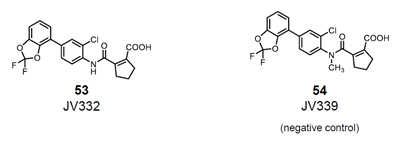
Chemical structures of JV332 and the negative control JV339.
JV332 (compound 53) is a potent NR4A agonist derived from optimization of vidofludimus-based scaffolds. It demonstrates strong agonistic activity across NR4A receptors and promotes neuroprotective gene expression. A structurally related inactive compound (JV339, compound 54) serves as a negative control.
Biological activity summary:
Physical and chemical properties for JV332 | |
Molecular weight | 421,78 |
Molecular formula | C20H14ClF2NO5 |
IUPAC name | 2-((2-chloro-4-(2,2-difluoro-1,3-benzodioxol-4-yl)phenyl)carbamoyl)cyclopent-1-ene-1-carboxylic acid |
AlogP | 5.71 |
TPSA | 84.86 |
No. of chiral centers | 0 |
No. of rotatable bonds | 4 |
No. of hydrogen bond acceptors | 4 |
No. of hydrogen bond donors | 2 |
Storage | Stable as a solid at room temperature. Store DMSO stock solutions (10 mM) at -20 °C. Use only 1 freeze/thaw cycle per aliquot. DMSO stocks beyond 3-6 months or 2 freeze/thaw cycles should be tested for activity before use |
Dissolution | Soluble in DMSO up to 10 mM |
Physical and chemical properties for JV339 | |
Molecular weight | 435,81 |
Molecular formula | C21H16ClF2NO5 |
IUPAC name | 2-((2-chloro-4-(2,2-difluoro-1,3-benzodioxol-4-yl)phenyl)(methyl)carbamoyl)cyclopent-1-ene-1-carboxylic acid |
AlogP | 5.27 |
TPSA | 76.07 |
No. of chiral centers | 0 |
No. of rotatable bonds | 4 |
No. of hydrogen bond acceptors | 4 |
No. of hydrogen bond donors | 1 |
Storage | Stable as a solid at room temperature. Store DMSO stock solutions (10 mM) at -20 °C. Use only 1 freeze/thaw cycle per aliquot. DMSO stocks beyond 3-6 months or 2 freeze/thaw cycles should be tested for activity before use |
Dissolution | Soluble in DMSO up to 10 mM |
References:
Sai M, Vietor J, Kornmayer M, et al. Structure-Guided Design of Nurr1 Agonists Derived from the Natural Ligand Dihydroxyindole. J Med Chem. 2023;66(19):13556-13567. doi:10.1021/acs.jmedchem.3c00852
Stiller T, Gege C, Saeb W, et al. Carboxylic Acid Bioisosteres Boost Nurr1 Agonist Selectivity. J Med Chem. 2025;68(15):16212-16226. doi:10.1021/acs.jmedchem.5c01140
Vietor J, Busch R, López-García Ú, et al. Structural Tuning of Vidofludimus for High-Efficacy NR4A Agonism. J Med Chem. 2026;69(3):3343-3361. doi:10.1021/acs.jmedchem.5c03217
We seek a talented and driven Data Scientist passionate about accelerating drug discovery through machine learning and AI to join our team at the Structural Genomics Consortium (SGC). As a Data Scientist at SGC, you will play a central role in developing and deploying state-of-the-art machine learning models that extract actionable insights from complex biomedical datasets, including DNA-Encoded Library (DEL) screens, to identify and optimize drug candidates for challenging protein targets.
The Structural Genomics Consortium Melbourne (SGC-Melbourne) is led by Professor Megan J. Maher and is dedicated to advancing challenging therapeutic targets through the integration of structural biology, mechanistic enzymology and chemical biology.
Based at the University of Melbourne, SGC-Melbourne develops open-access molecular tools, protein structures and mechanistic insight.
Dr Ivanhoe Leung is a Senior Lecturer in Biological Chemistry in the School of Chemistry and a Group Leader at the Bio21 Molecular Science and Biotechnology Institute of the University of Melbourne. He completed his undergraduate and DPhil in Chemistry at the University of Oxford, where he trained in the laboratories of Professors Christopher J. Schofield FRS and Timothy D. W. Claridge. Following postdoctoral research in the same groups, he joined the University of Auckland as a Lecturer in 2014 before moving to Melbourne in 2021. Dr Leung is an expert in nuclear magnetic resonance (NMR) spectroscopy, particularly its application to study protein-ligand interactions, enzyme kinetics and enzyme mechanisms. His research has been recognised by several awards including the University of Auckland Early Career Research Excellence Award, the RACI Welcome Award, the RACI Victorian Chemistry Supervisor of the Year Award and the ANZMAG Sir Paul Callaghan Medal.
Dr Leung's research combines structural biology, biophysics, chemical biology and multiomics to understand how enzymes are regulated and how they control complex biological processes. His laboratory uses NMR spectroscopy, X-ray crystallography, SAXS, cryo-EM, mass spectrometry and computational approaches to investigate enzyme structure, dynamics, interactions and function. His research focusses in three areas: 1) defining the molecular mechanisms that regulate enzyme activity, including allostery, conformational dynamics, oligomerisation, and regulation by metabolites and other biological molecules; 2) understanding how enzyme regulation controls metabolism, signalling and cellular adaptation; and 3) translating mechanistic insights into new applications in infectious disease, agriculture, biotechnology and sustainable manufacturing.
Megan Maher was awarded a PhD in Inorganic Chemistry from the University of Melbourne. She carried out postdoctoral research at the University of Sydney, Imperial College, London and Centenary Institute in Sydney, which were funded by a series of independent fellowships. Megan relocated to La Trobe University to take up a position as LIMS Senior Research Fellow and progressed to the position of Senior Lecturer and Associate Professor. In 2017 Megan was awarded the Georgina Sweet Award for Women in Quantitative Biomedical Science and in 2018 an ARC Future Fellowship. Megan joined the School of Chemistry and Bio21 at the University of Melbourne in 2019 as part of the University's Driving Research Momentum (DRM) strategy, she was promoted to Professor in 2023 and now holds a joint appointment between the School of Chemistry and the Department of Biochemistry and Pharmacology. Megan is currently the President of the Australian Society of Biochemistry and Molecular Biology and Chair of the Australian Academy of Science National Committee for Crystallography.
Megan is a structural biologist and bioinorganic chemist whose discoveries have revealed fundamental mechanisms of mitochondrial disease, metal homeostasis, membrane protein and metalloprotein structure and function. Her work has advanced how proteins assemble, acquire cofactors, and perform essential biological functions, generating insights across human health, infectious disease, and biotechnology.
The Structural Genomics Consortium (SGC) congratulates Benjamin Haibe-Kains on being named the 2026 recipient of the Francis Ouellette Community Award, presented by the Canadian Bioinformatics Hub. The award recognizes early- and mid-career leaders who have made exceptional contributions to strengthening Canada’s bioinformatics, computational biology, and data science ecosystem.
The AI-Driven Drug Discovery Group at the Vall d’Hebron Institute of Oncology (VHIO) in Barcelona, led by Dr. Albert Antolin, is seeking an outstanding Machine Learning Scientist to contribute to the development of next-generation ML methods for small-molecule drug discovery.